• Link to Facebook
  • Link to LinkedIn
  • Link to Mail
  • Link to Youtube
  • Advanced Product Search
  • Login / Register
  • My Account
  • Questions? | Email Us!
  • 480-948-5555
  • Industry Solutions
      • Industry Solutions

      • Our customers work in aerospace, automotive, energy, medical, industrial automation industries and test labs. If you are looking for inspiration or ideas, check out our solutions by industry.
      • Learn More
      • Aerospace
      • Agriculture
      • Automotive and Vehicle
      • Consumer Products
      • Education
      • Energy
      • Entertainment
      • Industrial Automation
      • Infrastructure
      • Internet of Things
      • Lifting
      • Manufacturing
      • Maritime
      • Medical and Healthcare
      • Natural Resources
      • Original Equipment Manufacturer
      • Test and Measurement
      • Weighing
  • Product Applications
      • Product Applications

      • Explore the diverse array of case studies, white papers, and application notes tailored to showcase the transformative potential of our products.
    • Applications Notes
      • Our skilled application engineers work with our customers to provide load, torque, multi-axis and force measurement solutions. Take a look at our library of Interface Application Notes.
    • Case Studies
      • Interface Case Studies are real examples of how our products are used for various applications, from packaging robots to launching rockets.
    • White Papers
      • Our technical white papers provide detailed insights, tips and expertise about various measurement technologies and use cases.
  • Products
    • Product Overview
      • Dynamic Product Categories
        • Complete SystemsComplete Systems
        • Load CellsLoad Cells
        • Mini Load CellsMini Load Cells
        • Load Button Load CellsLoad Button Load Cells
        • Multi-Axis SensorsMulti-Axis Sensors
        • Torque TransducersTorque Transducers
        • Load Pins, Tension Load Links, and Load ShacklesLoad Pins, Tension Load Links, and Load Shackles
        • InstrumentationInstrumentation
        • Digital InstrumentationDigital Instrumentation
        • WirelessWireless
        • Hazardous LocationsHazardous Locations
        • Calibration EquipmentCalibration Equipment
        • Load Cell SimulatorsLoad Cell Simulators
        • AccessoriesAccessories
        • G-SeriesG-Series
  • Product Guides
      • Interface Guides

      • Interface Guides are helpful resources to navigate our products. Our team has developed a series of instructional online tools that provide useful information about all the options available in our robust catalog.
      • Learn More
      • The Interface Selection Guide
      • Load Cell Selection Guide
      • Fundamentals of Multi-Axis Sensors
      • Multi-Axis Sensor Selection Guide
      • Mini™ Load Cell Selection Guide
      • Torque Transducer Selection Guide
      • Torque Coupling Selection Guide
      • Instrumentation Selection Guide
      • Complete Systems
      • Wireless and Bluetooth® Selection Guide
      • Cable Assemblies Guide
      • Accessories Selection Guide
      • Calibration Equipment Selection Guide
      • Load Pin Configuration Submission
      • Weighing Solutions Guide
      • Lifting Solutions Guide
      • Data AQ Pack Guide
      • BlueDAQ Software Guide
      • Caris Codes Guides
      • Interface Load Cell Field Guide
      • ForceEDU
  • Services
    • Interface Technical Services
      • 50+ years of combined experience calibrating and repairing load cells and 100,000+ calibrations performed annually.
    • ISO 17025 Scope of Accreditation
      • Interface calibration certificates are the most complete in the industry.
    • Calibration Services
      • Interface provides calibration services on load cells and other force measurement devices from nearly any manufacturer.
    • Repair Services
      • Interface provides repair services on load cells and other force measurement devices from nearly any manufacturer. Repairs include a complete evaluation of the device prior to repair and calibration upon completion.
    • Load Cell Troubleshooting
      • Performance of a load cell force (or weigh) measurement system is dependent upon the integrity of the physical installation, correct interconnection of the components, proper performance of the basic components which make up the system, and calibration of the system.
  • Custom Solutions
      • Custom Solutions

      • Interface Custom Solutions empowers you to utilize our expert engineering, design and manufacturing teams to build custom force, torque and specialty products that are customized to meet your exact needs, with precision.
      • Learn More
      • Custom OEM Solutions
      • Custom Integrated Solutions
      • System Level Calibration
  • Support
    • Locate Reps and Distributors
      • Interface’s success is due to our global network and partnership with its representatives and distributors.
    • Catalogs and Brochures
      • Interface offers downloadable PDF catalogs and brochures, including product, industry, and service guides.
    • Installation and Operation Manuals
      • Find installation and operation manuals for load cells, torque, multi-axis, load pins, links, shackles, instrumentation.
    • Software and Drivers
      • Download drivers, software and mobile apps.
    • Electrical Wiring and Diagrams
      • Electrical selection chart, load cell cable and connector wiring diagrams and more.
    • Technical Library
      • Our technical library covers cable length effects, glossaries, system calibrations, and load cell troubleshooting resources.
    • ForceEDU
      • Welcome to Interface’s ForceEdu – your go-to resource for training and professional development of Interface’s products and more. Here, you’ll find a wealth of educational materials, including training videos, 101 articles, blogs, and brochures.
  • Company
      • Company Overview

      • Founded in 1968, Interface is a U.S. based, women-owned technology and manufacturing company of the world’s best load cells, headquartered in Scottsdale, Arizona.
      • Learn More
    • Interface Capabilities
      • Interface is the world’s trusted leader in technology, design, and manufacturing of force measurement solutions. We empower engineers around the world to measure force and performance at the highest degree.
    • Trade Shows and Events
      • Throughout the year and across the globe, Interface hosts virtual ForceLeaders events, local ForceLeaders Summits, exhibits at trade shows and presents at global conferences.
    • Careers
      • Our business encompasses many different functions and capabilities, allowing you to explore careers in various fields. You can discover engineering, finance, manufacturing, marketing, product development, sales, and more opportunities.
    • Certifications and Compliance
      • Interface designs and manufactures high-performance sensors and instrumentation, ensuring ISO-compliant quality for the test and measurement market. We’re dedicated to delivering precision, reliability, and superior quality in every product.
    • InterfaceIQ Podcast
      • Listen to the InterfaceIQ Podcast, hosted by Max Newton and Molly Moment. The podcast created for new listeners, engineers, and innovators who want to learn more about force measurement technology!
  • Blog
  • Menu Menu
  • Shopping Cart Shopping Cart
    0Shopping Cart
You are here: Home1 / Blog2 / Proper Installation of LowProfile Load Cells Ensures Accurate Tension ...
Proper Installation Of Lowprofiles

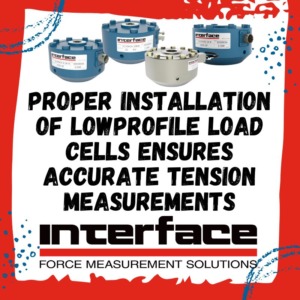
Proper Installation of LowProfile Load Cells Ensures Accurate Tension Measurements
April 22, 2025/in Blog /by Jamie Glass

Interface LowProfile Load Cell models 1000, 1100, 1200, and 3200 series are engineered for high-accuracy tension measurement applications.

Proper installation is paramount to achieving the most accurate and reliable results. Here are some tips related to the typical tension installation of these load cell series, along with key takeaways and common tension measurement applications using Interface’s popular LowProfile Load Cells.

The Foundation: A Rigid and Flat Mounting Surface

The accuracy of your load cell begins with its foundation. Our LowProfile load cells must be mounted on a flat and rigid surface that resists any appreciable deformation under load. If the mounting surface bends or twists, it will introduce unwanted forces and inaccuracies into your measurements.

We highly recommend using an Interface base or mounting plate specifically designed for your load cell model to guarantee this crucial stability. If using an Interface base isn’t feasible for your setup, ensure the alternative surface offers equivalent rigidity and flatness.

Tip #1 – Direction Matters: Axial Force Sensitivity

These load cells are engineered to measure forces acting directly perpendicular to their mounting surface, primarily the axial force. It’s important to understand that Interface load cells respond to forces in the axis perpendicular to the mounting surface. A load cell’s response to a non-axial force is proportional to that force times the cosine of its angle with the loading axis.

This means that any force applied at an angle to the intended direction of tension will have a reduced impact on the reading. To achieve the most accurate measurements, strive to align the applied tension force precisely along the load cell’s central axis. Minimizing off-axis loading is crucial for obtaining reliable data.

Tip #2 – Securely Anchored: Mounting the Load Cell

Once you have a suitable mounting surface, the next step is to attach the load cell securely. Position the load cell on the flat surface. Then, secure it by using a spanner wrench to tighten the load cell via one of the four strategically placed holes on the side of its base. This ensures the load cell is firmly fixed to your mounting structure. Note, using the spanner wrench only works when a base is installed on a load cell.

Tip #3 – Connecting the Force: Rod End Bearing and Jam Nut Installation

Let’s focus on how the tension force will be transmitted to the load cell. This typically involves installing a rod end bearing and a jam nut:

  • Install the rod end bearing. Carefully screw the rod end bearing into the threaded top of the load cell. Ensure it’s threaded to the proper depth for secure connection and force transmission.
  • Secure the rod end bearing with the jam nut. Once the rod end bearing is at the desired depth, it must be locked into place. This is accomplished by tightening the jam nut against the top of the load cell with a torque wrench. Using the proper torque specification for your specific load cell model is crucial. Consult the manufacturer’s documentation for these values.

Important Note for Higher Capacities: Securing the jam nut differs for load cells with capacities of 12,500 lbf or greater. Avoid using a torque wrench on these higher capacity models. Instead, pull the thread adapter to 110% to 140% of the load cell’s capacity to pre-load the connection. Then, hand-tighten the jam nut. This method securely fastens the jam nut and the thread adapter to the load cell, preventing damage.

Tip #4: Final Connection: Attaching the Clevis

With the rod end bearing securely in place, the final mechanical connection involves attaching the clevis. Align the holes. Carefully align the clevis pin’s holes on both the clevis and the rod end bearing. Once the holes are perfectly aligned, insert the clevis pin through them. Finally, secure the clevis pin using the supplied cotter pin. This prevents the pin from accidentally dislodging during operation.

With all the mechanical components correctly installed and secured, your system can safely apply tension force to the load cell.

Models 1000, 1100, 1200, and 3200 Series LowProfile Load Cell Typical Tension Installation

Common Applications for Interface LowProfile Tension Load Cells

These versatile load cells are used in various industries and testing scenarios where precise measurement of tension force is critical. Here are a few tension testing application examples:

  • Material Testing: Determining the tensile strength of materials like metals, plastics, and textiles by pulling them apart until failure.
  • Cable and Wire Testing: This involves evaluating the breaking strength and performance characteristics of cables, wires, and ropes under tension.
  • Suspension System Testing: Measuring the forces and loads in suspension components for automotive, aerospace, and other applications.
  • Weighing and Batching Systems: Implementing tension load cells in hanging scales or systems where materials are suspended and weighed.
  • Structural Monitoring: To ensure safety and integrity, assess the tension in structural elements, such as bridges, buildings, and pipelines.
  • Force Calibration: Using highly accurate tension load cells as reference standards for calibrating other force measurement devices.
  • Robotics and Automation: Measuring and controlling tension forces in robotic arms, actuators, and automated assembly lines.
  • Aerospace Testing: Evaluating the tensile loads on aircraft components, control surfaces, and landing gear.

Key Takeaways for Successful Tension Installation

  • Flat and Rigid Mounting: This is the non-negotiable foundation for accurate readings.
  • Axial Force Alignment: Ensure the tension force acts directly along the axis of the load cell.
  • Secure Mounting: Properly tighten the load cell to the mounting structure.
  • Capacity-Specific Torque: Follow the correct tightening procedures for the jam nut, especially the no-torque rule for higher capacities.
  • Sequential Installation: Follow the steps outlined for the rod end bearing and clevis attachment.

Adhering to the specified mounting procedures, including ensuring a flat and rigid mounting surface and using the proper tightening methods (especially the distinction between using a torque wrench for lower capacities versus a pre-load and hand-tightening for higher capacities),  is essential for the accuracy, reliability, and longevity of your Interface Models 1000, 1100, 1200, and 3200 series LowProfile load cells in tension applications. Incorrect installation can lead to inaccurate readings, sensor damage, and potentially unsafe operation.

Always consult the complete load cell model specifications and installation instructions for detailed specifications, precise torque values (where applicable), critical safety precautions, and any specific requirements unique to your application and the model.

By understanding the proper installation techniques, you can unlock the full potential of your Interface LowProfile load cells and achieve accurate and reliable tension force measurements in your specific application.

1000-1100-1200-3200-Installation-2
Tags: 1000, 1100, 1200, 3200, clevis, force, force measurement, installation, installation instructions, IQ Blog, IQBlog, jam nut, Load Cell Basics, Load Cells, low profile, LowProfile, rod end, Set Up, technical support, tension, tension applicatoins
Share this entry
  • Share on Facebook
  • Share on X
  • Share on Pinterest
  • Share on LinkedIn
  • Share on Reddit
  • Share by Mail
https://staging.interfaceforce.com/wp-content/uploads/proper-installation-of-lowprofiles.jpg 800 800 Jamie Glass /wp-content/uploads/Interface_White_Red.svg Jamie Glass2025-04-22 08:08:102025-04-22 08:50:49Proper Installation of LowProfile Load Cells Ensures Accurate Tension Measurements
You might also like
LOAD CELLS 101 Load Cell 101 and What You Need to Know
Shear And Bending The Basics of Shear and Bending Beams
AEROSPACE Interface 1 Taking Flight with Interface
MULTI AXIS SENSORS 2 1 Better Data and Performance with Interface Multi-Axis Sensors
ELECTRIC VEHICLE Interface 1 1 The Future of Automotive is Electric
Standards In Measurement 1 Quick History of Creating Standards in Measurement

SUBSCRIBE TO THE INTERFACEIQ BLOG

  • Remember to subscribe to Interface’s IQ Blog. It’s a must-read for anyone looking to stay informed and up-to-date on the world of load cells with expert insights, engaging content, and a fresh perspective.

Latest Posts

  • Technical Validation of Water Safety Equipment Across Maritime ApplicationsAugust 13, 2026 - 8:08 am
  • Complex Testing 6 Axis Bx8 DAQ
    Complex Testing with 6-Axis Load Cells and BX8 DAQ InstrumentationAugust 11, 2026 - 8:08 am
  • Moment 101
    Moment 101August 6, 2026 - 8:08 am
  • Rigging
    The Mechanics of Suspended Loads in Heavy RiggingAugust 4, 2026 - 8:08 am
  • INTERFACE TECH TALK Single Load Cell Platform Weighing
    Why Use a Single Load Cell for Platform Weighing?July 30, 2026 - 8:08 am

Explore our Products

  • Accessories
  • Calibration Equipment
  • Digital Instrumentation
  • G-Series
  • Hazardous Locations
  • Instrumentation
  • Load Button Load Cells
  • Load Cell Simulators
  • Load Cells
  • Load Pins, Tension Load Links, and Load Shackles
  • Mini Load Cells
  • Multi-Axis Sensors
  • Quickship
  • Torque Transducers
  • Wireless

All Products

  • Load Cells
  • Interface Mini
  • Load Button Load Cells
  • Multi-Axis Sensors
  • Torque Transducers
  • Load Pins, Tension Links, and Load Shackles
  • Instrumentation
  • Digital Instrumentation
  • Wireless Telemetry System
  • Bluetooth® Telemetry System
  • Intrinsically Safe
  • Calibration Systems
  • Accessories
  • G-Series

Contact Us

  • Feedback
  • Customer Support
  • Contact Form
  • Career Opportunities
  • Certifications and Compliance
  • Locate A Rep or Distributor

Solutions

  • ForceEDU
  • Custom Solutions
  • Industry Solutions
  • Application Notes
  • Animated Application Notes
  • Case Studies
  • White Papers
  • Interface Training Videos

Services

  • Calibration and Repair Request
  • Load Cell Troubleshooting
  • Software and Drivers
  • Technical Library

News

  • Events
  • Newsletter
  • Interface IQ Blog
  • InterfaceIQ Podcast
ISO 17025 Scope Accreditation
© Copyright - Interface - powered by Enfold WordPress Theme
  • Warranty And Repair Policy
  • Privacy Policy
  • Certifications and Compliance
Link to: New Force Measurement Education Resource Hub ForceEDU Link to: New Force Measurement Education Resource Hub ForceEDU New Force Measurement Education Resource Hub ForceEDUNEW ForceEDU Introduction Link to: Key Considerations for Overload Protection in Load Cells Link to: Key Considerations for Overload Protection in Load Cells Consider Overload ProtectionKey Considerations for Overload Protection in Load Cells
Scroll to top Scroll to top Scroll to top

We use cookies to enhance your browsing experience, serve personalized content, and analyze our traffic. By clicking "Accept All Cookies", you consent to our use of cookies.

Accept All CookiesReject AllCookie Settings

Cookie and Privacy Settings


How we use cookies

How we use cookies

We may request cookies to be set on your device. We use cookies to let us know when you visit our websites, how you interact with us, to enrich your user experience, and to customize your relationship with our website.

Click on the different category headings to find out more. You can also change some of your preferences. Note that blocking some types of cookies may impact your experience on our websites and the services we are able to offer.

Essential Website Cookies

Essential Website Cookies

These cookies are strictly necessary to provide you with services available through our website and to use some of its features.

Because these cookies are strictly necessary to deliver the website, you cannot refuse them without impacting how our site functions. You can block or delete them by changing your browser settings and force blocking all cookies on this website.

Google Analytics Cookies

Google Analytics Cookies

These cookies collect information that is used either in aggregate form to help us understand how our website is being used or how effective our marketing campaigns are, or to help us customize our website and application for you in order to enhance your experience.

If you do not want us to track your visit to our site, you can disable tracking in your browser here:

Other external services

Other external services

We also use different external services like Google Webfonts, Google Maps and external Video providers. Since these providers may collect personal data like your IP address we allow you to block them here. Please be aware that this might heavily reduce the functionality and appearance of our site. Changes will take effect once you reload the page.

Google Webfont Settings:

Google Map Settings:

Privacy Policy

Privacy Policy

I agree to the terms and conditions laid out in the Privacy Policy

Update Your SettingsDo not accept and hide notification
Open Message Bar Open Message Bar Open Message Bar

Please share your location to continue.

Check our help guide for more info.

share your location