Technical Validation of Water Safety Equipment Across Maritime Applications
 Global maritime safety relies heavily on test and measurement solutions to keep pace with the growth of international shipping, increased use of personal watercraft, advancements in autonomous underwater vehicles, rescue robots, submersible exploration, and modern defense fleet deployments. Across all sectors, international maritime regulatory bodies continue to enforce stricter mandates.
Maritime safety depends on millions of individual life-saving appliances, first-responder rescue assets, and critical vessel recovery systems. With thousands of water-related casualties reported annually across international waterways, equipment reliability directly determines survival rates during emergency operations. Ensuring the functional integrity of these systems requires rigorous physical-force validation, ranging from sub-pound tactile-release testing on individual survival gear to multi-ton tension monitoring on commercial vessel launch davits and heavy mooring lines.
Interface’s load cells, load pins, load shackles, tension load links, digital instrumentation, and wireless telemetry systems provide the empirical mechanical data needed to verify structural compliance and operational safety thresholds.
Validation of Individual Personal Flotation, Rescue, and Emergency Gear
Personal flotation devices, harnesses, and inflation triggers must operate within strict force limits. An inflation valve pin needing excessive force can fail during manual deployment, while a quick-release harness with too low a threshold risks premature detachment under heavy waves.
To verify gear, water safety equipment designers and engineers perform tension and compression tests on actuation lanyards, buckles, and fabric seams, using load cells to record peak tension during release. Proper capacity selection of a miniature load cell allows evaluation of micro-force triggers requiring less than 3 lbf with high resolution. Fatigue and material testing on vest webbing measures strain from repeated pulls to confirm seam integrity before tearing.
Rescue and recreational watercraft also require rigorous testing. Personal watercraft (PWC) engine cut-off lanyards are tested with load cells to confirm reliable ignition shutdown during ejection without false releases. Tow hitches on PWCs towing inflatable sleds are tested with wireless tension links to record forces, ensuring hitches and latches can handle heavy, cyclic, and impact loads.
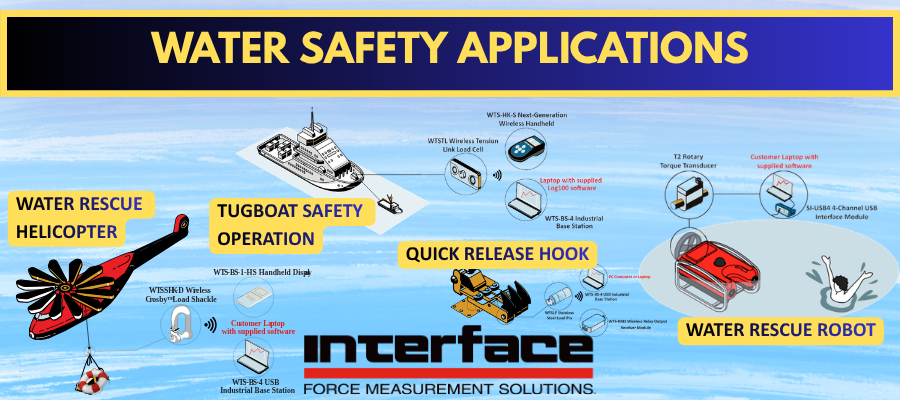
Advancements in water safety are now employing robotics. Check out the Water Rescue Robot application for more details.
Structural and Operational Testing of Lifeboat Launching Systems
Vessel evacuation systems, including lifeboat davits, winch housing structures, and fall wire terminations, are subject to stringent safety mandates under international maritime regulations. These systems must undergo both static proof loading and operational brake performance verification.
Static proof testing evaluates sustained load-holding capacity without structural damage. During these procedures, davit arms and winch foundations are loaded to elevated multipliers using calibrated water bags or test weights. Submersible load shackles installed directly into the lifting train measure applied force while optical instruments track static deflection across structural members. Measuring static deflection verifies that the metal operates within its elastic region and will not suffer permanent structural deformation under maximum working loads.
Operational deployment testing evaluates the winch braking system’s performance while the loaded craft descends at full operational speed. Abruptly applying the brake at maximum lowering speed introduces high mechanical forces. Wireless tension link load cells or load pins installed in the primary sheaves record force spikes during brake engagement. Wireless telemetry system modules eliminate trailing cables that could tangle in winches, transmitting continuous load data to a central receiver for immediate force profile analysis.
Heavy Maritime Rigging, Mooring, and Anchor Line Monitoring
Large vessels depend on heavy rigging, tow winches, and mooring systems to maintain position and prevent breakaway events in harbor or offshore environments. Uneven load distribution across multiple mooring lines can cause individual line failure, leading to a progressive cascading collapse of the entire mooring array.
IP-rated tension links, load shackles, and load pins provide continuous force monitoring across deck winches and anchor lines. Load pins replace standard clevis pins in sheave assemblies, incorporating orthogonal strain gage bridges that account for changing wire rope wrap angles across the pulley. Submersible load cells built with environmentally sealed stainless-steel enclosures provide valuable data during immersion and high hydrostatic testing. By transmitting real-time line tension data to handheld monitors and displays, operators keep equalized line tension and receive immediate alerts if tension levels approach defined safety limits.
Additional Water Safety Applications Using Measurement Solutions
#1 – Personal watercraft (PWC) rescue sled bridle and hitch testing use wireless tension links to measure peak transient shock forces on PWC tow hitches and rescue sled bridles during high-speed surf rescue maneuvers.
#2 – Engine cut-off switch (ECOS) validation benefits from using miniature S-beam load cells to verify that safety lanyard ignition kill switches release within precise force thresholds to prevent rider dragging or accidental engine shutdown.
#3 – Recreational tow eye and cleat hull integration needs high-capacity tension load cells to perform static pull testing on stern tow eyes, ski pylons, and deck cleats to confirm composite hull layup strength under heavy tow loads.
#4 – Inflatable rescue boat (IRB) transom thrust and torque verification occurs using thrust stands equipped with LowProfile Load Cells. These sensors help to evaluate outboard motor mount structural endurance and transom bond strength under high dynamic propulsion forces.
#5 – Commercial diving tether and umbilical strain monitoring requires load cells in line with diving umbilical winches to check continuous tension, preventing excessive tensile pulls on communication and air supply lines during deep-sea operations.
# 6 – Maritime rescue helicopter hoist hooks use winches and auto-release hooks that undergo tensile load validation to verify immediate mechanical release under emergency overload conditions.
#7 – Marine watertight hatch and bulkhead latch verification benefits from using compression load cells to measure sealing force along perimeter dogs and hydraulic latches to confirm full gasket engagement under high hydrostatic sea pressures.
#8 – Towing hawser and escort tug tension monitoring needs in-line wireless tension shackles to monitor real-time peak loads during ship-assist maneuvers, preventing sudden line snapback and protecting deck crew safety.
Types of Measurement Products Used in Water Safety Validation Testing and Monitoring
Interface’s large catalog of measurement technologies, from sensors to instrumentation, provides standard options for critical water safety projects. For custom solutions, including equipment integration and OEM solutions, it offers a range of options from cable-free devices to full systems for on-site testing. Here are the most common products used for these types of applications:
- LowProfile Load Cells
- Miniature Load Cells and S-Beam Load Cells
- Sealed Stainless Load Cells
- Load Button Load Cells
- Hermetically Sealed Submersible Load Pins
- High-Capacity Submersible Load Shackles
- Tension Load Links
- ATEX and IP-Rated Sensors and Instrumentation
- Indicators and Signal Conditioners
- Wireless Telemetry Systems
- Custom Sensors
Water Safety and Measurement Accuracy is A Life-Saving Partnership
Water safety gear, covering personal, rescue, and commercial maritime equipment, depends on precise mechanical testing to avoid failures in actual use. Using load cells, load pins, and wireless telemetry in testing gives engineers reliable data on force, torque, and weight during all operational scenarios.
By carefully measuring details such as micro-force actions, fatigue thresholds, and static deflections, sensor-based validation guarantees that essential life-saving equipment and vessels function dependably in emergencies.
MORE INFORMATION