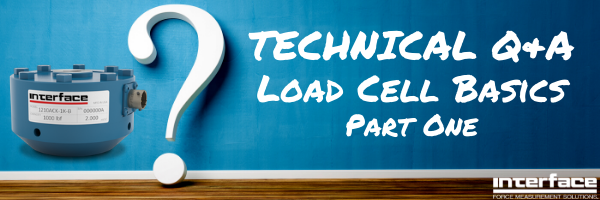
Another way to engage with our team of experts is to contact us directly with your exact technical questions and support requirements. We also know that by sharing commonly asked questions of our experts can be a helpful resource. In our new series, Technical Q&A, we plan to highlight FAQs that we get from your peers.
LOAD CELL BASICS TECHNICAL Q&A PART 1
In our first post in this series, we answered a series of technical questions from our recently hosted webinar, Load Cell Basics. In our new post, Load Cell Basics Technical Q&A Part One, we answered the following nine questions in detail.
Why Does Interface Use Proprietary Strain Gages?
What Type of Temperature Testing Do You Do on Interface Load Cells?
Is Temperature Compensation Achieved Using Dummy Gages?
Do You Have Software to Read TEDS Available to Use with Interface Load Cells?
Is it Acceptable to Regularly Use a Load Cell Above Its Specified Capacity?
Does Variable Altitudes Impact Performance?
Can Cables Influence Temperature Errors?
Is Creep Due to Material or Strain Gages?
Are All Load Cells Intrinsically Safe?
Read the answers to these questions here. We will be posting our new Technical Q&A IQ Blog Series each month. If you need immediate help, please reach out and let us know what we can do to support you.
SIZING UP S-TYPE LOAD CELLS
S-type load cells, also known as s-beams, get their classification from the “S” model design of the cell. This shape is ideal for measuring well-controlled tension and compression forces.
Interface S-Type Load Cells are very cost-effective, highly accurate, easy to mount, and offer flexibility. They are also smaller than typical load cells, making them best for when there are limitations in space or requirements for smaller test product dimensions.
Engineers and testing labs often choose the Interface S-Type Load Cell for the precision, size, material, and ability to fit in small spaces. Interface often sees these cells in applications for weighing, used in test machines, as well as part of OEM product designs to provide continuous performance measurement. Read more here in our S-Type 101 post.
Interface has a variety of miniature s-type load cells including sealed, micro-size, fatigue-rated, high-temperature ratings, low height, overload protected and intrinsically safe to meet all types of testing protocols and plans. You can see all the s-type models here.
INVENTIVE MULTI-AXIS + INSTRUMENTATION WEBINAR
We are excited to announce that we have added a new ForceLeaders online event to this year’s calendar. Our solutions experts Ken Bishop and Keith Skidmore will be hosting a live discussion that will detail the growing capabilities and use cases for 3 and 6-axis load cells and advanced instrumentation in Inventive Multi-Axis + Instrumentation Solutions.
In this webinar held on Tuesday, November 16, we will focus our discussion on the following topics and showcase use cases and answer questions. Register here.
3-Axis + 6-Axis Multi-Axis Sensors
Why Use BX8 Instrumentation
Benefits of the BSC4
What About Mounting Plates
Introducing New Force Plate Options
Outlook on Multi-Axis Systems
Please join us for our next event on November 16, 9:00 AM Pacific, Noon Eastern. Register here.
TURNING AN ACTIVE COMPONENT INTO A SENSOR
Innovation continues to push for greater automation, real-time data collection and remote monitoring of products used in the manufacturing of industrial and consumer goods. Interface sensors are increasingly utilized to drive better efficiency through the production and use of machines, technology, and commodities. For example, using Interface sensors to drive automation helps to significantly improve process quality because it helps to eliminate human error and drives long-term cost savings by speeding production. Another benefit of utilizing sensors is to analyze products in use. This continuous feedback helps optimize performance and stability over time, leading to product advancements and improvements.
Working with our OEM engineers and sensor experts, we partner with our customers to lend our competence in the development and production of tools and technologies that measure force, torque, weight and more. Working together, we help to ensure OEM products have the right technology to drive the right behaviors and results. In our latest OEM Solutions White
Paper, Turning an Active Component into a Sensor, we detail how sensors bring products into the next generation. Get your copy here.
WHAT ELSE IS HAPPENING?
AUTOMOTIVE TEST EXPO SHOWCASE – Our team of application engineers and custom solutions experts are onsite in Novi, Michigan, demonstrating new instrumentation, our multi-axis load cells, load buttons, AxialTQ and a brake pedal load cell. Register + Attend for Free.
POWERING ELECTRIC VEHICLE TESTING – Learn more about some of the sensor technologies we supply leading manufacturers and vehicle testing labs in this new post that highlights EV solutions. Read more.
NEW CASE STUDY HIGHLIGHTS SUBMERSIBLES AND WIRELESS – Interface products are used to test and measure continuous performance for waterborne vessels, dock equipment such as cranes and lifting apparatus, submersible devices, and offshore machines. Learn more.