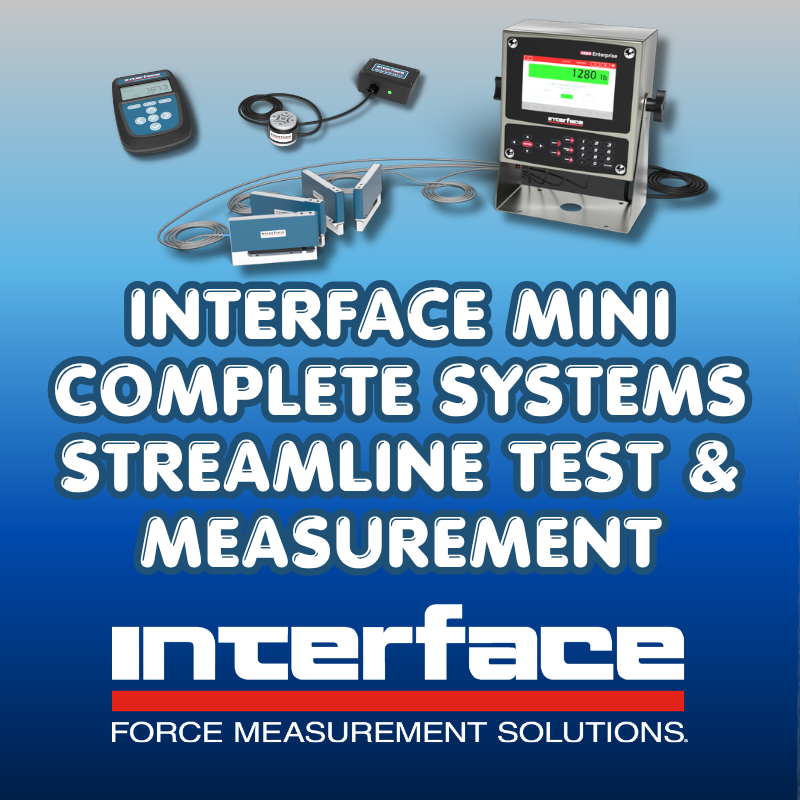
Interface Mini Complete Systems Streamline Test and Measurement
 Interface offers a wide range of miniature sensors, primarily classified by measurement capacity and dimensions. For decades, Interface has supplied these miniature measurement devices for use in test labs worldwide, across a wide range of industries, for integration into machines, as components of larger testing apparatus, and to support equipment and end products with continuous measurements.
Interface miniature sensors include S-type load cells, miniature beam (MB) load cells, load washer and load button load cells, rod-end load cells, and other specialized models, such as brake pedal load cells and platform scale load cells.
TIP: Use the Mini™ Load Cell Types and Options Guide to preview the full range of Interface’s miniature sensor product family.

Defining Miniature Sensor Complete System Requirements
Integrating miniature sensors to measure force, torque, or weight into test equipment and products with tightly constrained spaces presents distinct engineering challenges. Beyond selecting the correct sensor capacity and physical form factor, engineers must match electrical specifications, manage cable resistance, configure signal conditioning, and account for total system calibration.
Purchasing discrete components (a sensor from one supplier, an amplifier from another, and generic cabling) often leads to integration delays, scaling errors, and troubleshooting cycles. Interface complete systems address this by delivering factory-matched, pre-wired, and system-calibrated packages ready for immediate installation and operation.
Here are examples of Interface Mini Complete Systems:
- SSM or SSM2 Sealed S-Type Load Cell and ILM In-Line IO-Link Amplifier IO-Link Compatible System
- SSB Sealed Beam Load Cell and 1280 Programmable Weight Indicator and Controller System
- SMA Miniature S-Type Load Cell and 9825 General Purpose Indicator System
- LBM Compression Load Button Load Cell and SGA AC/DC Powered Signal Conditioner System
- MB Miniature Beam Load Cell and 9825 General Purpose Indicator System
- SSMF Fatigue Rated S-Type Load Cell and DMA2 DIN Rail Mount Signal Conditioner System
- LW General Purpose Load Washer Load Cell and WTS Wireless Telemetry System
- SPI Low Capacity Platform Scale Load Cell and 1280 Programmable Weight Indicator and Controller Weighing System
- BPL Pedal Load Cell and BTS Bluetooth Telemetry System
The Technical Purpose of System-Level Calibration for Mini Complete Systems
In an Interface Complete System, the transducer, interconnect cabling, and instrumentation (such as a digital display, DIN rail signal conditioner, USB digitizer, or wireless telemetry module) are calibrated together at the factory as a unified measurement loop. The resulting calibration certificate documents the verified performance of the entire hardware chain.
Calibrating a sensor independently of its instrumentation introduces hardware and electrical variables that can compromise measurement accuracy in both laboratory and machine operations. Here are three common challenges to consider:
- Signal Conditioning Discrepancies: Shunt calibration or theoretical calculations cannot fully account for analog-to-digital conversion nonlinearities, excitation-voltage drift, or input-impedance variations within the amplifier.
- Cable Effects: In millivolt-per-volt (mV/V) strain gage circuits, lead wire resistance directly affects sensitivity and temperature performance. When a transducer is calibrated with its specific application cable and mating connectors attached, the final system documentation accounts for line resistance.
- Scaling and Setup Errors: Manually entering calibration constants, zero balances, and span values into digital indicators, PLCs, or DAQ modules creates opportunities for configuration errors.
IMPORTANT! Interface engineers and load cell experts strongly recommend that, when pairing an Interface sensor and instrument, you select the optional system-level calibration to verify that all components work together and eliminate these potential compromises.
Configurable Sensor and Instrumentation Pairings
Interface Complete Systems represent baseline configurations and examples of common assemblies. Interface configures our miniature sensor types with compatible instrumentation to meet the dimensions, capacity requirements, and communication protocols defined by your use case requirements.
Miniature sensor selection depends on the force vector and the available mounting space. For inline tension and compression testing, compact S-beam models like the SMA, Sealed SSM2, and Fatigue-Rated SSMF offer high output and long cycle lives in cyclic test rigs or continuous machine monitoring. In pure compression applications with strict height limitations, LBM Load Button Load Cells and LW Load Washers fit directly under fasteners, structural supports, and machine tooling.
When low-capacity force measurement is needed in medical devices, robotic grippers, or automated assembly stations, MB Miniature Beam Load Cell and REC Rod End Mini provide the required sensitivity. For rotating joints, small drive shafts, or fastener verification equipment, MRT Miniature Flange Reaction Torque Transducers capture rotational forces within compact assemblies.
Learn more about Interface’s Mini Load Cell Products in this 101 video.

Instrumentation is selected to match the data destination, whether feeding a local operator, a PC workstation, or an automated control network. Benchtop and panel indicators like the 9825 General Purpose Indicator and 9325 Portable Sensor Display deliver local visual readouts, tare controls, and limit relays for process alarms. For direct integration into plant PLCs and industrial controllers, DIN rail and in-line signal conditioners such as the SGA, DMA2, and ILM IO-Link modules convert low-level strain signals into standardized 0 to 10 V, 4 to 20 mA, or digital bus communication.
When computer-based testing is preferred, DIG-USB digital modules convert signals directly into engineering units over USB without external power supplies. At the same time, WTS wireless telemetry transmitters reduce cable-management issues on moving machine tracks and rotating fixtures.
Matched Accessories, Cabling, and Hardware Integration
 A reliable measurement system extends beyond the transducer and instrument. Signal integrity and mechanical longevity in industrial automation and test lab environments depend heavily on correct cable shielding, proper connector pinouts, and mechanically sound mounting interfaces.
Interface Complete Systems include factory-terminated, shielded, low-noise cables cut to exact application lengths, eliminating the need for on-site wiring or field soldering. Interconnects are fitted with industrial circular connectors, quick-disconnect couplings, or hermetic feedthroughs wired directly to factory standards. Review our Sensor Interconnect Cable Assemblies Guide for more details.
To ensure proper load introduction and prevent off-axis or bending moments from inducing measurement error, systems are paired with matched mechanical fixtures. This includes alignment load buttons, threaded adapters, mounting plates, and spherical rod ends tailored to the specific thread pitch and load line of the miniature sensor, ensuring straightforward integration whether mounting into a test stand or embedding directly into a production machine.
Five Operational and Time-Saving Benefits of Complete Mini Systems
Standardizing pre-configured, factory-calibrated miniature systems delivers measurable reductions in integration overhead and operating costs across both testing and manufacturing programs:
- Reducing engineering and assembly time eliminates the hours typically spent wiring connectors, configuring DIP switches, scaling displays, and performing deadweight manual or hydraulic calibration.
- Streamlining procurement and setup for engineers and machinery builders integrating force monitoring into equipment. Receiving a pre-calibrated test and measurement system simplifies machine building and OEM procurement and bill of materials, eliminates multi-vendor coordination, and standardizes assembly processes.
- Single-source quality and expertise remove unknown technical challenges of combining separate sensor, cable, and instrument suppliers when diagnosing signal noise or communication discrepancies.
- Immediate system commissioning with out-of-the-box readiness enables technicians to mount the sensor, connect the pre-labeled cable, power the unit, and start collecting accurate data immediately.
- Traceable recalibration and system maintenance are critical in test and measurement. When routine quality audits or maintenance schedules require recalibration, the entire hardware chain is returned, serviced, and re-certified together, maintaining complete traceability and reducing administrative overhead.
Tailored System Configurations for Miniature Applications
The complete system packages include measurement hardware pairings designed to meet common footprint and data acquisition requirements across industries. Because operational parameters vary across aerospace test labs, automotive assembly lines, medical devices, and industrial machinery, every component can be configured to meet the specific requirements of your testing plan or integration project.
Interface Application Engineers work directly with you to define the parameters and needs of your complete miniature load cell or torque transducer system, including the exact cable, sensor, instrumentation, and accessories needed to deliver a verified, ready-to-operate, calibrated measurement system.
ADDITIONAL RESOURCES


