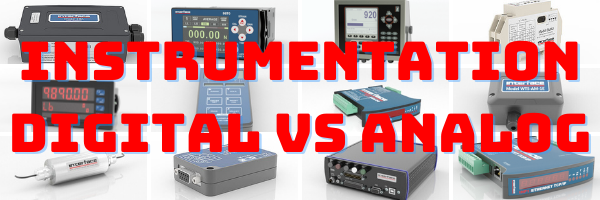
Interface sells a wide variety of instruments designed to help take data measured on a load cell or torque transducer and convert it into a readable form. There are many types of instrumentation available, and we continue to add new and updated products each month.
Analog output for test and measurement instrumentation has been the most popular for decades. Analog signals are sent in a continuous stream, faster than digital and easier to work with. Additionally, analog systems take up far less bandwidth than digital.
Growing in use are the many options for digital instrumentation,including indicators, transmitters, controllers, converters, output modules, data acquisition systems, wireless technologies, and supporting software. These instruments take load cell or strain bridge input and deliver data output in a variety of protocol and bus formats. Digital instrumentation provides greater measurement accuracy and digital resolution.
Choosing Between Analog and Digital Instrumentation
When deciding between analog and digital instrumentation output capabilities, here are a few questions to add to your evaluation:
Are you connecting to an existing network?
Are you connecting to an existing digital acquisition device?
What is your budget?
How many sensors are you connecting?
Understanding which output, whether analog or digital, is an important starting point when selecting the right instrumentation. Read Instrumentation Analog Versus Digital Outputs to get answers and insights into these questions, along with the benefits of each type of output.
Determining accurate weight is a key data point that product engineers and equipment manufacturers require across all types of industries. Whether they need the weight data for transporting an object, lifting the object, or using weight in a design specification, accuracy in weight measurements is fundamental for safety and function.
Large and small objects can differ greatly in the weighing methods and types of sensors that will provide the most accurate data. Will the sensor be manufactured into machines for continuous weight monitoring, or will it be used in conjunction with other hardware components as a system? Case in point, read more about how the waste management industry uses Interface solutions. To construct the best accurate weighing solution for your exact requirements, contact our application engineers.
Machine and Equipment Manufacturers Use Interface Products for Performance Data
For innovators in equipment and machine manufacturing, data is everything. Quality data can make the difference between average and high-quality products. In the lab and while in production, every bit of test and measurement output allows OEMs to make improvements in performance and accuracy before the release of the product.
This is especially true in the design, test, and evaluation of high-volume manufacturing where an increasing number of companies are implementing automation to speed production. To ensure consistent and repeatable quality, it’s important that there are capabilities to constantly gather data and monitor automated systems. If a machine is about to break or needs calibration, an automated system should be able to notify them without any human intervention.Read more about OEM use cases and solutions here.
There Is Always More!
EXPANDING OUR WIRELESS TELEMETRY SYSTEM LINE – Did you know that you can get a completely wireless system, including our load cells, load pins, shackles, tension links, instrumentation, and more? Check out the entire WTS product group here.
GAMING HARDWARE BENEFITS FROM FORCE MEASUREMENT SOLUTIONS – Learn how gamers benefit from sensors in improving real-world simulation experiences, better performance, and durability of the equipment. Learn more.
FACE OF INTERFACE FEATURES KARLA SALAZ – Check out our latest ForceLeaders interview with Interface’s Custom Solutions Procurement Specialist. Read more about Karla here.