Application Considerations When Choosing the Right Load Cell
Every load cell model type has defined specifications in capabilities. The range of models is quite expansive when you consider that Interface has more than 35,000 products along with options for custom and engineered to order solutions.
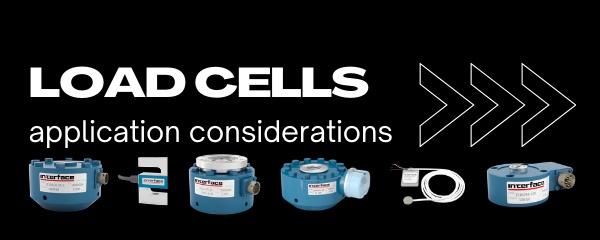
Interface load cell options range from our most popular standard LowProfile® load cell, all the way to specialized miniature load button load cells that are a fraction of the size of our jumbos. A better way to describe this range is through capacities of force measurement that span from 1 lbf (500 gf) to 2 million lbf (9,000 kN). So, where do you begin?
Four primary considerations are important when selecting the right force measurement solution, and in particular, a load cell. These considerations are related to mechanical, electrical, environmental, and performance specifications.
Here is a quick list to help you get started in choosing the right load cell:
Mechanical Requirements: Dimensions and Mounting
Electrical Requirements: Output and Excitation
Environmental Requirements: Temperature and Moisture
Performance Requirements: Accuracy and Thermals
If you are interested in learning more about your options, please join us for our upcoming event, Load Cell Basics, tomorrow at 9:00 AM PST | 12:00 PM EST. Keith Skidmore will specify load cell designs, how they work, and highlight factors that impact accuracy and performance. Seats are limited, and we are near capacity, so register now.
If you would like to review your needs, our team of expert Application Engineers is available to review your exact requirements to ensure you choose the right sensor for your application. Contact us here.
Constructing a Case for Load Pins
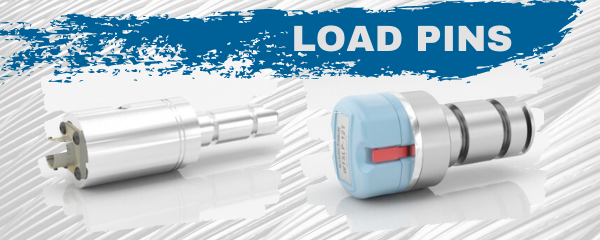
A load pin is a cost-effective type of load cell that can replace bolts, clevis, sheave, and equalizer pins, as well as other load-bearing components to measure tensile and compression forces. They are easy to install, robust, and customizable. Load pins are internally gauged with a bored center containing strain gages, allowing them to convert force into an electrical signal for engineers to accurately collect data. Load pins have expanded in popularity and are now often used to test and measure force, load, and limitations in a much larger variety of applications for construction equipment, industrial machines, nautical craft and equipment, aerospace, and civil engineering
applications. Read more about the benefits of using load pins.
SAVE THE DATE! If you would like to learn more about load pins and their growing popularity, join our upcoming ForceLeaders Forum, Use Cases for Load Pins, on February 25 at 9:00 AM PST. Register here for this new ForceLeaders hosted event. Leading this online conversation is our applications expert, Elliot Speidell. Don’t miss it! Save your virtual seat today.
Load Shackles Fundamentals
Load shackles are rugged in design and used to provide accurate and reliable measurement of tensile loads as well as support applications for harsh and challenging environments. We highlighted load shackles in our recent Load Shackles 101 InterfaceIQ post here. Load shackles are commonly utilized in industrial, aerospace and defense, agriculture, and construction applications for lifting, moving, and weighing objects to provide real-time monitoring and performance optimization. Interface offers a wide variety of
load shackle designs for different environments and force measurement needs, ranging from 2.2K to 2205K lbf. Our load shackles come in both cabled and wireless as well as environmental resistance options, including flameproof and IP67. Visit our overview here to see the range of solutions.
Extra: What to Watch!
If you can’t make it to our online events, we will be posting these insightful webinars on our Interface YouTube channel here. You can also find product demonstrations and one-of-a-kind animated applications. We just posted a new Robotic Arm
Application Note that is a must-see. It’s a great way to show how our new ConvexBT Load Button Load Cells are used in this industrial automation robot. We also have a new AxialTQ Engine Dynamometer Application Note that highlights the Interface AxialTQ Wireless Rotary Torque Measurement System used to measure and calculate the torque and rotational speed (RPM) of the engine in real-time accurately and simultaneously collecting data.



 SAVE THE DATE! If you would like to learn more about load pins and their growing popularity, join our upcoming ForceLeaders Forum, Use Cases for Load Pins, on February 25 at 9:00 AM PST.
 If you can’t make it to our online events, we will be posting these insightful webinars on our


